30 January 2012

Bottom feed


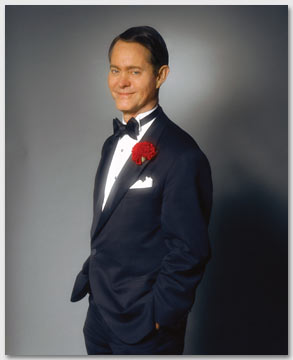
Not sure how long it's going to be up for, and not sure whether it's only available in the UK, but the Guardian website is currently making available a live stream of Paul McCartney's new album of standards, Kisses on the Bottom. I am listening to it and not sure what I think of it yet, but if so minded you can hear it here.

I'll report back later. But it does occur that here is an alternative to the fantasy Beatle album of tracks taken from the the quartet's first solo efforts. Apart from Lennon - unless he sang a snatch of Scatterbrain in an interview, perhaps - the rest have recorded standards. Yes, George Harrison too: he's recorded the Hoagy Carmichael song Baltimore Oriole and Hong Kong Blues (the latter also covered by Jerry Lee, incidentally), not to mention Harold Arlen's Between The Devil And The Deep Blue Sea. Cherry pick from Ringo's Sentimental Journey then listen to Macca.

New Rock-It Radio Shows

Having an unpleasant task to do today, involving a long-delayed cleaning duty, I stocked up with  MP3 downloads of Rock-It Radio shows to make the time pass more agreeably. I've already written about Clarke Davis' show celebrating the prelapsarian pop, rock'n'roll and soul of 1963, but today I was particularly struck by - and grateful for - an edition of Denny McConnell's Music of Your Mind show, numbered #3994 - uploaded here on the 29th January, so it will be available for a while. Unlike some other Rock-It shows, nothing particularly rare but a very high quotient of doo wop records which I had loved for a long time. There isn't a tracklist on the website yet but if you haven't dipped your toe into the chilly waters of doo wop yet it could be a good place to start.

And for those wishing to hear the music of the late Johnny Otis, there are two separate shows commemorating his music currently on Rock-It - I don't imagine he will feature on Radio 2 over the following week, somehow. And where else would I have found out that his recording of Harlem Nocturne was a standard arrangement, as recorded earlier by Ray Noble, only speeded up a little by Otis?

Although I've mentioned Rock-It from time to time in this blog, I don't think I've been vocal enough in my appreciation. Do check it out if you like fifties/early sixties music, as you will find a huge amount to entertain you. There is merchandise you can buy on the website or you can buy good quality CDs of the shows - the downloads are pretty lo-fi, although for me that's part of the charm.


Postscript:

I didn't mean chilly, did I? I meant murky. Sonic murk.

29 January 2012

King Monster or He Never Could Forget


Heard this song on a recent edition of Clarke Davis' The Big Show on Rock-It Radio and couldn't resist sharing it. I didn't know who the writers were but am not surprised to learn it was a Goffin and King composition. It's witty and initially I couldn't quite tell whether it was a sendup - though I suppose the real answer is that it is and it isn't.

The essential joke is that just as parents react in horror to rock'n'roll in general, by 1963 (Clarke's current shows mine the lesser known songs from that year) the form had been  around long enough for older teens to feel nostalgiac about the dances which they learnt, back in what for them were the good old days, being supplanted by the likes of the twist:

I remember
You looked like a queen
You were only sixteen and so sweet then

I remember
How your eyes caught my glance
As we started to dance to the beat then

It was heaven
We were angel with wings on
Or devils with springs on our feet then

I'll never forget
The night that we met
And I did the ma - a - ashed
Potatoes with you

You were dancin'
With some other soul
And I went and I stole you from him then

I remember
How you held me so tight
When they dimmed every light in the gym then

It was magic
Though your kiss made reel
So it still made me feel so in trim then

I'll never forget
The night that we met
And I did the ma - a - ashed
Potatoes with you

As the saxophone played
And you told me you cared
And together we sha - ared a pizza
Just to know you were there
Was too much to bear

Now we're older
And the music is changing,
The dances are strange to our feet now

I get dizzy
Cause we go round and round
Back and forth up and down  to the beat now

Though we're twistin
I'll remember forever
One dance that we'll never repeat now

I'll never forget
The night that we met
And I did the ma - ashed
Potatoes with you

Then there's a great spoken outro, with just the right balance of crazed conviction and hint of amusement:
Honey, now everyone's dancin' the twist, and the stomp, and the bird - and even the watusi. But honey in this heart of mine there was only one dance with soul, and that was the ma - a - ashed potatoes. Oh honey the mashed potatoes was the only dance that ever had any soul at all, and honey you knooow what I'm talkin' about ...

And off he fades into Goffin-assisted immortality.

25 January 2012

Good news about local radio cuts


Good news in my hard copy of the Guardian today, which I can share with you via the magic of the internet.

Other listeners to Spencer Leigh - and local radio fans in general - will be pleased to know that
Lord Patten is poised to announce a financial reprieve for the BBC's 40 English local radio stations, which are facing £15m of cuts that would have prompted changes including the merger of neighbouring stations' off-peak programmes.

The chairman of the BBC Trust will address the Oxford Media Convention on Wednesday, and he is expected to ask Mark Thompson, the director general, to find money to mitigate cuts that would have led to the loss of 280 jobs.
You can read the full article here. [Update: BBC news page including audio clip here.]

But we're not out of the woods yet, as it remains to be seen how much money will still be cut, as the article continues:
BBC local radio insiders gave the news a cautious welcome. One BBC source said that any reversal of the planned cuts would be welcome but added that employees would want to see the detail. "If they only knock £1m or £2m off the savings target then it will only be scratching the surface. If they were talking about £5m coming back [leaving cuts of £10m] then you would start to see that making a real difference."
And will specialist music shows such as Spencer Leigh's On the Beat necessarily be among those saved, if cuts still have to be made somewhere?
The source added: "All eyes will be on what they want us to save. Is it the lunchtime show, is it the quality of the journalism, or is it a bit of both?"
But it's the first bit of good news about this situation, and an indication (I hope) that the protests of listeners to Radio Merseyside and other local stations have registered with the Beeb.

And looking at Spencer Leigh's website, here, I see that advance notice for On the Beat shows now goes up to February 25th. In fact, here are all the forthcoming editions currently listed:
Saturday 28 January 2012 (5.30-8pm) - My Darling Clementine, the country duo featuring Michael Weston King and Lou Dalgleish, Curtis Stigers, plus a guitar pull from Kevin Littlewood (writer, "On Morecombe Bay"), Ian Prowse (Amsterdam) and Ethan Allen.

Saturday 4 February 2012 - Tony Cartwright (Part 1), the Huyton boy who managed Tom Jones and Engelbert Humperdinck and associated with the Rat Pack and Elvis Presley

Saturday 11 February 2012 - Tony Cartwright (Part 2)

Saturday 18 February 2012 - Michael Hill who went to school with John Lennon

Saturday 25 February 2012 - Juke Box Jury

Link to most recent On the Beat here.

Update 26/1/12: 

A further article posted on the BBC website, here, seems to be saying that financial cuts will be minimal:


The Trust conclusions mean the BBC Executive must find an extra £10m a year to 2015 to replace the savings it would have made through these specific cuts. The Trust wants the money found through efficiency savings rather than output reductions.

But the Trust is not demanding complete abandonment of the plan for afternoon programme sharing between local radio stations in regions of England. Lord Patten said: 'We accept that in some cases that might still be the best option.'
Nevertheles, with specific regard to shows like Spencer Leigh's, the good news is that
The Trust also wants the BBC to try to retain more of local radio's specialist off-peak content and to minimise projected cuts in local radio newsrooms.
So I think we can be reasonably optimistic.

15 January 2012

Serendipity in Cyberspace (Ken Sykora documentary)


Other fans of Ken Sykora (I wrote about him earlier, here) will be interested to know that a documentary, The Man With the Jazz Guitar, has been made and that The Ken Sykora Radio Station is being launched on mixcloud - go to mixcloud and put  his name into search. At present there is a kind of sampler lasting about twelve minutes with snippets from various shows and family members talking, but I hope that full editions of Serendipity with Sykora may be available at some point.

He kept copies of more than 300 programmes throughout his career (about a tenth of his output) so fingers crossed. Because of my vintage and where I grew up it was those Serendipity programmes on the newly formed Radio Clyde which I remember, but the likes of Paul McCartney would have listened to the BBC's Jazz Club

You can find out more about The Man With the Jazz Guitar here. The site includes the information that his personal archive includes 3 complete Guitar Clubs from 1958 and 1960, his first Django programme of 1956 and his appearance on the BBC’s Desert Island Discs. You will find on the documentary site links to some teaser clips of the film, and Radio Clyde's Andy Park appears, talking about working with him:


Ken was far and away the best programme maker, I mean he could have been an essayist or a storyteller. He could have been an architect sometimes I thought, because his programmes were so thoroughly well planned: he knew everything that was going in there from the word go and they were a joy. I never had to edit them or anything like that.

To close, an edited extract from my previous blog post about Ken Sykora, originally part of a series commemorating broadcasters who influenced my musical tastes:
He possessed an intimacy of manner perfectly suited to late night listening, fostering the illusion that the broadcast was intended solely for you.The title of his programme allowed him to play whatever he wanted, assuming some chance connection with the previous piece could be found, and the result was a beguiling mixture of novelty songs and jazz, knitted together with odd anecdotes and what came across as an absolute ease in the studio. I really wish I'd taped some of those shows at the time; alas, I have no record of any of them. It felt like a friend was informally guiding you through some records he happened to like, saying whatever came into his head about them or any loosely related matter, wholly at ease.

He was very fond of Peggy Lee but it's the oddities I remember: it was Serendipity which introduced me to Spike Jones and His City Slickers, in particular Cocktails for Two. Some records such as Hoagy Carmichael's version of Barnacle Bill the Sailor straddled the novelty/jazz divide, with Bix Beiderbecke and others blowing wildly between the verses - and Sykora had an eye for the pleasing detail, informing us that the use of a rude word - "I can't swim a bloody stroke" - had caused this to be banned at the time.

On the down side he seemed inordinately fond of the Stargazers, or maybe it's just that songs like Twenty Tiny Fingers and Close the Door, They're Coming in the Window (featuring what sounds like the return of Barnacle Bill), once heard, cannot easily be forgotten. To counterbalance that, the Lovin' Spoonful's Nashville Cats,  a paen to guitar picking, was a particular favourite of his.

I can remember the keen pleasure of the programme, the seemingly endless new (to me) discoveries it contained, but I've no idea how long it ran. I've got a feeling, in fact, that he was shifted to an earlier slot for a programme specifically about the big bands, but have no idea whether this was a matter of choice. I enjoyed that programme, too, although it meant the element of unpredictability which made the Serendipity show so enjoyable was lessened. But it strikes me now how artfully assembled his programmes were: those novelties were a way of hooking the casual listener into a programme which had no artificial musical divisions.

What was most important about his programme was a sense that the music and personality were one and the same - that you didn't wait for one to be over so you could enjoy the other - and that you were happy, above all, simply to spend time in his avuncular company. His sign-off - "From me, Ken, adios" - always seemed personal to you.


Update 18th Jan: 

The good - very good - news is that complete editions of Serendipity with Sykora will indeed be included on the Ken Sykora Radio Station.

Update 24th Jan: 
You can listen to Ken Sykora's 1956 BBC programmea about Django Reinhardt on mixcloud here.

3 January 2012

Eric and Ernie by Peter Bowker with Victoria Wood as Sadie (repost)


This is a repost as Peter Bowker's drama has recently been repeated by the BBC. The link to the BBC player at the end of the first part below still works - the programme will be available to watch again on iplayer for a further four days, if you haven't seen it.

This isn't really to do with music - or only with music as an incidental ingredient - but I feel compelled to write something about Peter (not David) Bowker's dramatisation of the early years of Morecambe and Wise which was shown on BBC 2 last night and will presumably be available to readers in the UK for a further week on the BBC's iplayer here.

As with Beatle-related biopics I am both helped and hampered by my knowledge of the subject, so that it's hard to judge it - or, indeed, to submit to simple enjoyment.

Others can do that. Mine is another voyage.

29 December 2011

Spencer Leigh On the Beat Christmas Special and Clarke Davis and the Big Show Pt 43


Have just been listening to Spencer Leigh's Christmas Special On the Beat and wanted to recommend it while it's still available on BBC iplayer (until 8pm GMT Saturday evening). Click on the link here.

As ever, an eclectic mix of music - he says he wanted to open up with Louis Armstrong's version of The Night Before Christmas but couldn't find it anywhere on the internet, so there's a version by Huey "Piano" Smith and the Clowns instead. I think I heard it a while back on Russell Davies' programme - Louis Armstrong's recitation, that is. Tracks follow by Kate Rusby, Anthony Newley, James Taylor, Perry Como - and a beautiful version of Pretty Paper, the Willie Nelson recorded by Roy Orbison, sung live by My Darling Clementine. Oh, and I should mention that the Kate Rusby song is a carol sung to the tune of On Ikley Moor - and, as he must, Spencer makes the connection with Bill Oddie's spoof of Joe Cocker. The programme ends with what may be a 1971 rehearsal of a bluesy Christmas ditty by Elvis, in very good form. Re the future of On the Beat, he says:
All the submissions to the BBC Trust have gone in now about the future of local radio. I hope that I'm going to be doing this show throughout 2012 but who knows? But I'm definitely going to be here next week - we've got a big show next week, from 5 to 8, New Year's Eve Special. I've got a lot of guests coming in and I've given them all a rock book for Christmas, so we'll see what they make of them.

As radio has been on my mind in recent posts I'd also like to put in a plug here for Clarke Davis, whose forty-third show devoted to the music of 1963 has just been uploaded to the Rock-It Radio site, findable here. You can download it as an MP3 or a realplayer file. (And if you are new to this blog, you can read our dialog[ue] about doo wop music by clicking on "Steve's Kewl Doo Wop Shop" above.)

Clarke's shows are sheer joy for me: although a great deal of American pop filtered through to Britain, I've discovered through these broadcasts just how much didn't: and hearing such a broad spread of pre-Beatles riches has been an education.

Clarke did play a Beatles track in a recent programme but really the British Invasion (and I speak as a Brit - a Scot, even) was the beginning of the end. I reviewed a documentary about doo wop a while back (full review here) and still remember the sense of resignation when one deejay was speaking, several decades on, about the effect of the Fabs on the music he loved:
"Things changed," he says, simply - and again you have a sense that the afficiandos have had a long, long time to accept the fact that while this music may never go away it is unlikely ever to be a huge force again.
And the beauty of Clarke's shows is that it's not all trashy-but-loveable pop: there is doo wop, soul and so much else still being made at that time. Which ties in with Spencer Leigh's Christmas show: there ought to be room in our hearts for Perry Como and for Elvis, especially when the latter is in such fine form.

And not just at Christmas.

Oh, and I see that I can now embed the Orioles' Oh Holy Night, as referred to in the previous post, so here it is. Bit late but a thing of beauty. And if you tell me that Elvis Presley never heard this, I must beg to differ.


Postscript: The On the Beat New Year's Eve Special has just aired and will be available on BBC iplayer here, until next Saturday evening. The second track played was this:

25 December 2011

Where Elvis learnt to sing

I make no apology for featuring once again the Valentines' A Christmas Prayer. I love the soulful, ragged feel. And no Richard Barret, no Frankie Lymon. It really is that simple. I like the detail that Barrett lived above the shop where the young Lymon worked. Also Barrett's overprotectiveness towards (I think) the Chantels, which I suspect may have been related to his inability to protect Lymon. On the half hour documentary Promise to Remember, filmed around the time the surviving Teenagers were regrouping - the final shot of the PBS shows that Frankie's replacement for a gig at Stitt Junior High (which Barrett used for rehearsals) is ... a woman. No chance of the voice breaking, and time will bring in changes more slowly. But the line which stays with me from the doc is Barrett saying that Lymon's early demise will haunt him for the rest of his days.

Anyway, that's not very Christmassy. So here is A Christmas Prayer. This is doo wop singing as I like and understand it, and I commend it to you:


Oh, and if you're wondering about the strapline, that's because I was going to embed the Orioles' superb version of Oh Holy Night but the PC in the hotel where I type this can only access some aspects of youtube. Still, there's a pool and the food is delish. Merry Christmas one and all. And try to listen to Oh Holy Night yourself. Go here. It's listed as an alternate take but it sounds like the version I know from CD. Anyway, the point is that towards the end ("Oh ni-i-ight, oh hooo - leee ....") Sonny Till bends the notes in a way that suggests Presley must have been a keen student.

18 December 2011

Of Spencer Leigh and other radio reminders


[screengrab]

Before I say anything else, can I remind readers who also listen to Spencer Leigh's On the Beat show on BBC Radio Merseyside that the deadline for responding to the BBC Trust's online questionnaire about local radio is Wednesday December 21st?

If you want to show your support for the programme, please consider answering at least Question 7 of the eight questions provided. The above image is only a screengrab so read more in the previous post if you haven't done so already or go direct  to the BBC Trust questionnaire here.

On his show yesterday Spencer thanked listeners for Christmas cards and gifts but modestly said it wasn't necessary as the BBC license fee paid for the programme. But the questionnaire is a way in which all fans of the show, like me, can show our appreciation and perhaps extend the life of the programme - and you don't have to live in the Radio Merseyside region, as BBC iplayer makes locals of us all. I have filled it in myself and forwarded the comments which readers added to the previous post. Fingers crossed that On the Beat will continue for a lot longer.


I've written in the past about broadcasters who influenced my musical tastes but it occurs to me I never wrote  to them at the time to say so, and in several cases it's too late, so it's good to be able to do something in this case. 

But the fact that it never occured to me in the past even to drop a brief note of thanks to those broadcasters whose enthusiasms did so much to shape mine does make me think more generally that the job of deejay or broadcaster (one can't imagine Hubert Gregg thought of himself as a deejay) is, at least in part, an act of faith: the tangible signs of appreciation which come the broadcaster's way must be only a small fraction of the listenership. But the broadcaster must sit in the studio, imagining a sympathetic ear for his words - which is more or less the meaning of Vernon Green's word "pismotality."

Let me whisper sweet words of pismotality


Green was imagining a lover, but the intimacy of listening to the radio - especially late night shows, under the covers - is not dissimilar.

So as this is an anniversary of sorts - two years and a bit since I began this blog - and as my thoughts are with radio, let me salute once again those voices who shaped my tastes, with brief extracts from the series of earlier posts about them. Click on the names in bold to be taken to the full posts. Ken Sykora is pictured below, right, with Stephan Grapelli, former partner of his hero Django Reinhardt. The original post includes a link to Sykora's own version of Honeysuckle Rose, which nods to the Reinhardt-Grapelli recording.Here's how I summed up the effect of his 1970s late night Radio Clyde programme on me:


The title of his programme, Serendipity with Sykora, allowed him to play whatever he wanted, assuming some chance connection with the previous piece could be found, and the result was a beguiling mixture of novelty songs and jazz, knitted together with odd anecdotes and what came across as an absolute ease in the studio. I really wish I'd taped some of those shows at the time; alas, I have no record of any of them. It felt like a friend was informally guiding you through some records he happened to like, saying whatever came into his head about them or any loosely related matter, wholly at ease.


I'm happy to report that Carmel Gregg, Hubert Gregg's widow, read my piece on the great man and seemed to approve. You can find out more about his career and buy his autobiography, which details his long theatrical career, here. Comparing his broadcasting style with that of Sykora, I wrote:
You could say that Gregg's presentation was more mannered than Ken Sykora's, but it didn't seem like that in the execution. Even if the programmes were audibly scripted, as opposed to Sykora's air of an informal chat, a similar intimacy was conveyed. In an age of prattle, that careful preparation felt like a courtesy, not a barrier. And so you learnt to accept phrases which would have sounded artificial coming out of any other presenter's mouth, like "No more for a se'enight," when the half hour had sped by yet again, and even grew to relish the inevitability of the pause you could have driven a car through during the middle of his sign-off: "And au revoir ... to you."


Just as it's said that Hutch (a Gregg favourite) had the power to make the audience in a vast variety hall feel as though they were enjoying a recitation in an elegant drawing room, these and other Greggorian turns of phrase had the effect of drawing listeners into a happy band of fellow conspirators who refused to acknowledge the end of a golden age of English and American music which stretched from the twenties to, I suppose, the late forties. 


Whatever I didn't learn from Hubert Gregg or Robert Cushman I absorbed, almost unknowingly, from Benny Green; cruel friends used to delight in pointing out that all my spoutings about music were cribbed from his programme, which may have been truer than I cared to admit.

I didn't know it at the time, but Green was gradually and painlessly filling me with knowledge which was ultimately to prove professionally useful as well as a source of pleasure and metaphorical enrichment. 
But I can't leave out those names whom I discovered later, once my tastes were more or less established. They have enhanced the pleasure of listening and brought some unexpected discoveries to my ears, but we're talking consolidation, not Damascene conversion. First of all, the one who carried on Benny Green's work:


Like Ken Sykora, Benny Green, Hubert Gregg and Ian Whitcomb [discussed below], he is also a musician, which may have helped foster the catholicity of taste on display; the programme's subtitle is "The art, craft and inspiration of the popular song." 

The show appears to be scripted, but he has a real gift for succinct, accessible phrasemaking. It's different from Hubert Gregg's conscious stylisation, more like ordinary speech - but in a more compact, vivid form than the unscripted alternative, just as a current advert on British television for some kind of wonder yoghurt (or some such) boasts of its invigorating effects with the slogan: "You - but on a really good day."

Lorenz Hart, for example, is summed up as "Pint-sized genius of the lyric and tragical boozer" and we're told Spike Jones is "well known for taking the sweetest rose and crushing it till the petals fall - with a thunderous crash."

These brief quotes don't do justice to his links, where four or five interconnected ideas may whizz by in the transition from one record to another, with his trademark waspish understatement in a slightly raised voice inviting you into a joke. 


I only discovered Ian Whitcomb's radio show about eighteen months ago - not long before happening upon Spencer Leigh's, in fact.
Like many another in the 60s, Whitcomb had an epiphany on hearing Zimmerman. In his case, however, this happened to be ragtime pianist Professor Dick Zimmerman, who "rescued me from rock & roll, setting me on the road backwards" - in which direction he has been strolling ever since, stooping to pick up discarded tin pan alley sheet music as he goes; he has even written an acclaimed book about the development of the popular song from its late nineteenth century roots, After the Ball.
Both Ian Whitcomb and Spencer Leigh have written extensively about music. Their areas of expertise may differ but I think another remark I made in the post might stand equally as an argument for the importance of Spencer Leigh's On the Beat programme. I said of Ian Whitcomb that
[His] awareness of the deep, tangled roots of popular music means that he is able to make the most illuminating comments in his show en passant, seeing the sort of connections others wouldn't.
And that's it for me - that is what drew me to most of the broadcasters above: Ken Sykora would play Peggy Lee and Spike Jones but also the Lovin' Spoonful's Nashville Cats, no doubt because it was about the joy of guitar playing, and that transcended boundaries - and I remember that, like Ian Whitcomb, he was also drawn to Hawaiian music. Popular music of the twentieth century is all interwoven, and Spencer Leigh's show also demonstrates that. So a final reminder: if you value On the Beat, as I do, please consider that BBC Trust questionnaire (direct link at top or see previous post) before it's too late. Again, the deadline is December 21st. (2011, if you're reading this many years hence.)
That would be a rather good place to stop, except that there are two more things I want to say, as evidence of what Kenny Everett might have called "intertwangularity."The first is that I recently heard Spencer remark on his show that he loved Russell Davies's programme.


And the second is a recent memory. I saw  the New York cabaret singer Steve Ross perform a few weeks ago in a cabaret venue, the Pheasantry in the King's Road, Chelsea and had the chance to talk to him briefly afterwards.
The show, a tribute to Irving Berlin, featuring a mix of well known and more obscure numbers, made a big impression on me, for several reasons. The act of listening, staring across the otherwise empty table, called to mind a former partner with whom I associate the recordings of Hutch: they formed a soundtrack to to our time together, especially in the earliest days when one little room really was an everywhere.
I'm not sure whether it was a particular Berlin song also recorded by Hutch, or simply the conviction which Steve Ross brought to the songs, but either way I felt a sharp pang for an irretrievable past.

And there was another thing about that performance, which is related to my decades of radio listening to the likes of Hubert Gregg and Ken Sykora. Odd as it may sound, although I have been listening to and loving that sort of music for over thirty years, I don't think I had ever sat down at a cabaret style show like that before. Ever. The songs seemed alive in a way not possible through archive recordings broadcast over the airwaves.

And when I mentioned to Steve the people I had admired, like Hutch, and Mabel Mercer - familiar to me from both Benny Green and Robert Cushman's shows - I learnt they were known to him too: Mabel Mercer in particular had been, he said, a big influence. And the name of Robert Cushman was fondly greeted: he even praised his singing - which, I admit, is further than I would be prepared to go.

You could even say that the evening was a kind of culmination of a process - that is, if you were minded, like me, to tie a ribbon of sorts around this post. Let's have a go, anyway. Ahem. (clears throat, assumes solemnity of manner)

I listened as a teenager to love stories in song whispered through my transistor late at night.

Later, the whispering served another purpose: a backdrop to my own particular notion of some semblance of The Real Thing.

Now, thanks to the passion and the artistry of Steve Ross on that recent evening, the songs have been foregrounded once again. But this time I am more aware - and I'm talking about Berlin in particular, though it could equally apply to others - of the magic, or the vitality, or whatever you want to cry it, of these artefacts.

They are at once simple and profound. Direct, universal statements which somehow feel personally tailored at the same time. They are not The Thing Itself - real or otherwise - but they remind us of The Thing Itself. And they suggest that it's important. And they, at least, endure and they bring consolation as well as the odd stab of pain.

Most of all, maybe, they make me feel part of a larger world.

You can find Steve Ross's website here. He says:
So much of cabaret is about love. It's the emotion we're always trying to be reminded of most of all.


17 December 2011

Violent Playground to be released on DVD


At the boy's home, his gang is having a rock'n roll party. The radiogram is going full blast, the room is full of frenzied boys.
McCallum's face grows strained. He leaves Baker in the doorway and joins the gang, who make way for him in the centre of the floor.


It looks like Violent Playground (screenplay by James Kennaway and directed by Basil Dearden) is finally going to be released on legitimate DVD, mid January 2012. I don't know whether the fact that the film culminates in a siege at a school may have delayed its release on DVD but, as might be expected from Dearden, this is not merely a sensational piece. I've written about the film in passing in some earlier posts but thought it might be worth collecting those scattered notes here - not a full-blown review, just some observations which may be of interest.

The title music, a horrible cinema-type idea of rock'n'roll, was written, incredibly, by Paddy Roberts (the South African Noel Coward to Jake Thackray's Yorkshire model), but there is, nevertheless, an extremely powerful and disturbing scene in which young David McCallum and his hoodlum friends, sans females, do a strange kind of trancelike dance to this would-be crazy beat as a gesture of defiance and contempt when Stanley Baker's juvenile liaison officer dares to enter his home.


The film, written by James Kennaway (Tunes of Glory) has elements of On the Waterfront - there's a moment where you feel McCallum's character could go either way but Peter Cushing (in the Karl Malden role, if you will) misses his opportunity - and pays pretty heavily later.


The ending, as with Jame Kennaway's screenplay for Tunes of Glory, directed by Ronald Neame, is bleak - even bleaker, you might say, than Tunes of Glory, in which Jock's crack up (superbly portrayed by Alec Guinness) at least indicates he feels the enormity of what he has done. McCallum's character in Violent Playground proves to be beyond redemption, however, so at the film's conclusion the focus shifts to saving his younger brother and sister from going the same way.


But it's that scene in which McCallum and his pals obscurely threaten lawman Stanley Baker which is the most memorable, and the fact that they do it not with knives and fisticuffs but by the simple device of surrendering absolutely to the hypnotic effect of the devil's music.


There, in a single scene, you have rock'n'roll from a terrified adult perspective: the boys do nothing, beyond swaying a little; maybe they're even so stoned (metaphorically speaking) by the music that they're incapable of violence, but that makes it more disturbing, somehow. Throughout that scene they are, to Baker's Juvenile Liaison Officer, an alien tribe, wholly unknowable, not the kind of loveable artful dodgers you can at least get some kind of a handle on. No chucklingly administered cuff on the ear will tame these demons in waiting.

It's a great cinema moment, however unfair it may be, as this article, quoted at the start of this post, suggests:


A piece on the film on the BFI's screenonline website (readable in full here) makes clear that
James Kennaway's script was inspired by an actual experiment that was carried out in Liverpool in 1949.There, a small number of policemen were rebranded Juvenile Liaison Officers and given specific responsibilities to familiarise themselves with local youth crime from the incidents themselves down to the root causes (a theory that anticipated the Labour Party's "tough on crime, tough on the causes of crime" approach unveiled over forty years later).
Interesting to note, too, the response of locals (the film is set in Liverpool) to the filming:
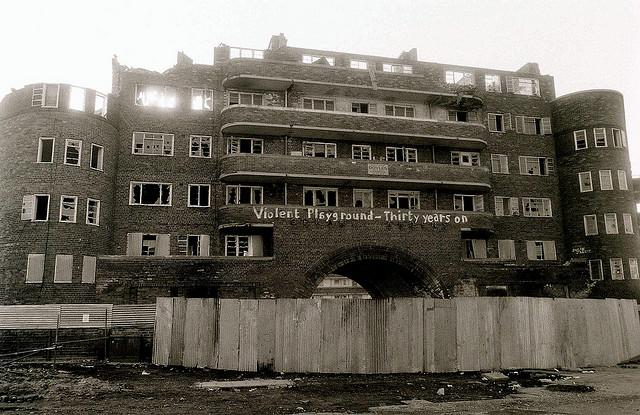
In order to emphasise an almost drama-documentary feel of authenticity, Dearden shot the film on location amongst the art deco tenements of Gerard Gardens, believing them to be representative of a Liverpool slum. However, his set dressers nonetheless had to exaggerate the dilapidation, and the locals later objected to the way their home had been co-opted into Dearden and Kennaway's central thesis that poverty breeds crime.


Find lots of pics from Violent Playground on the davidmccallumfansonline website here; several images above have been taken from there. The Reel Streets website, here, has then and now images of the Liverpool locations used in the film.

Below, Gerard Gardens shortly before demolition: 


Original posts mentioning Violent Playground: 

On Again! On Again! Or Strangers on a Train (Jake Thackray - the connection is that a Thackray-loving penfriend lived in nearby Caryl Gardens)

Gnome Thoughts ... 5 (Part of a series speculating on David Bowie's early musical influences, this mentions Paddy Roberts) 

Gnome Thoughts ... 6 (David Bowie/Ken Pitt culture clash)

Statcounter