9 December 2017
Spare the Rod (1961 film with Max Bygraves)
Directed by Leslie (father of Barry) Norman, who produced The Cruel Sea, and starring Max Bygraves as an idealistic teacher, the young Richard O'Sullivan as a pupil, plus Geoffrey Keen and Donald Pleasance, this is a film to slot in with Violent Playground and other late fifties/early
sixties British films which illuminate the times.
28 November 2017
In praise of Rock & Roll Graffiti (1999)
[There are technical problems with the layout of this much-read post - go here for a tidier and revised version.]
If, like me, you've been tantalised by the many clips on youtube of a TV show entitled Rock & Roll Graffiti, the good news is that most of that show, hitherto available only as an expensive DVD box set, can now be obtained on two reasonably priced 3 disc sets; I'm based in the UK and bought them from America for around £14 each. These are the covers to look for:
5 October 2017
A.A. Milne Part 3 (Lovers in London)
Possibly anticipating renewed interest in his work with the release of the film Goodbye Christopher Robin, Bello Books have recently reissued a range of titles by A.A. Milne, available as ebooks or print on demand copies.
For those already acquainted with his writing for adults, the most intriguing among these will undoubtedly be Lovers in London. A collection of pieces originally written for the St James Gazette, one of the many evening papers hungry for material when the likes of Milne and P.G. Wodehouse were starting out in the early 1900s, it didn't have much success when originally published in 1905. Milne later took pains to ensure it wouldn't resurface, so it's no surprise to discover that it's not exactly a masterpiece, but its reappearance after over a century is still worth celebrating.
The reason that the original articles weren't written for Punch, whose editorship Milne had seen as his destiny since leaving Cambridge, is simple. Although he had already started contributing to that magazine he considered that it hadn't yet started to reward him appropriately. Assuming the rate would go up after a few pieces had been accepted, he learnt that the proprietors felt "the honour of writing for Punch was considered to be sufficient reward at first." Milne decided that "I had had the honour, and I couldn't afford to sustain it."
3 October 2017
A.A. Milne Part 2 (Goodbye Christopher Robin)
I have now seen Goodbye Christopher Robin, the new film exploring the relationship between A.A. Milne and his son. As mentioned in the previous post, the screenwriter Frank Cottrell-Boyce has preempted criticism from those who might have read Ann Thwaite's biography of Milne:
26 September 2017
A.A. Milne Part 1
There is likely to be a renewal of interest in A.A. Milne when the film Goodbye Christopher Robin is released this Friday. Neglected novels and short story collections have already been reissued by Bello and a new biography is in the pipeline, although I can't imagine how this could possibly replace Ann Thwaite's superb and comprehensive A.A. Milne: A Life. (The forthcoming book, by Nadia Cohen, was credited as the source of a rather skewed piece about Milne in the Sun a few days ago, which does not inspire confidence.)
25 September 2017
Radio adaptation of That'll Be The Day on BBC iplayer
A radio adaptation by Ray Connolly of his screenplay for the 70s film That'll Be the Day has just been broadcast and will be available - to US and UK listeners alike - on BBC Radio iplayer for one month. Above is the image used to illustrate it on the BBC website.
As would be expected from the original writer it's a pretty faithful adaptation, although the different medium does bring about a change in emphasis: with Jim as narrator, the reasons for his actions can be made more explicit. He talks, for example, of detecting a sense of triumph in his best mate Terry when the latter occasions Jim's humiliation at a university dance, which helps explain Jim's later decision to sleep with Terry's girlfriend on the eve of his own wedding - though he also admits he did it partly because he could.
29 August 2017
No No Place Like Home, no Peep Show (sort of)
Listening to the first episode of Robert Webb's memoir How Not to Be a Boy, serialised this week on Radio 4, I was surprised to hear a reference to No Place Like Home. Of all the sitcoms in all the world this was the one which inspired him to become a performer - or at least set the seal on his decision.
Not that he offers an unqualified tribute to the writing ability of Jon Watkins. Watching an episode of the show in the afterglow of his own comic triumph in a school play, the young Webb is far from uncritical:
21 August 2017
Tommy Hunt on Spencer Leigh's On the Beat, BBC Radio Merseyside
Have just heard, and strongly recommend, a fascinating interview with Tommy Hunt, one of the two last surviving members of the Flamingos from their glory days, on Spencer Leigh's ever-dependable On the Beat programme on BBC Radio Merseyside. It was broadcast yesterday and will be available on BBC iplayer for another 29 days; it's radio rather than television so I believe US readers can also access it; the iplayer page is here.
As ever, Spencer's wide-ranging musical knowledge helps him draw the best out of his subject, a man who is an important part of several strands of music history - and, remarkably, still performing at the age of 84. He will be appearing at London's 100 Club in October.
He was born, we learnt, in a carnival tent in Pittsburgh - his father was a jazz drummer - but he is now living in Pontefract in Yorkshire, of all places, having fallen in love with a woman at a theatre in Wakefield. The marriage has not survived but he is still there - a perfect location for a Northern Soul legend.
10 August 2017
Bill Putnam and Universal Recording
One significant name was left out of the recent series of posts about the Flamingos' early work: Bill Putman, who ran Universal Recording. The technical quality of the Flamingos' Chance and Parrot sides reflects the fact that both companies used Putnam's studio at 111 East Ontario Street, situated off Michigan Avenue. He would have engineered their tracks, although presumably label bosses Art Sheridan and Al Benson would have been the respective producers. Johnny Keyes' memoir Du-Wop places Putnam in the studio when the Magnificents were recording Up On the Mountain early in 1956:
"OK, let's try another one fellas. Move in on the mike a little, mid-range voices," a voice boomed through the playback speakers. It was Bill Putnam, the staff engineer. He was also one of the faces that was glaring down at us from the control room.
6 August 2017
Flamingos # 17: Get With It & I Found a New Baby
The Flamingos had a larger backing band than usual for two numbers in their final session for Al Benson's Parrot Records. The website devoted to the Parrot and Blue Lake labels notes:
They had been recently performing with Paul Bascomb's group at Martin's Corner on the West Side, but Al Benson preferred to use a studio band led by Al Smith on the date. A four-horn front line (Sonny Cohn, trumpet; Booby Floyd, trombone; Eddie Chamblee, tenor saxophone; and Mac Easton, baritone sax) lent a big-band atmosphere to the two uptempo numbers: "I Found a New Baby," which was held back from release, and "Get with It."There is no mention of Red Holloway who, it may be remembered, was present, according to the same website, on the other two numbers from that session:
On "Ko Ko Mo" and the ballad, "I'm Yours," the group was accompanied by just Red Holloway, with Horace Palm (piano and organ), Quinn Wilson (bass), and Paul Gusman (drums).Did Holloway also contribute to the two big band-style numbers?
3 August 2017
Flamingos # 16: I'm Yours & Ko Ko Mo
[Marv Goldberg]
The Flamingos' second (and final) session for Parrot also yielded some notable sides. The pick of the bunch is the ballad I'm Yours, even though it was only a B side for their cover of Gene and Eunice's Ko Ko Mo.
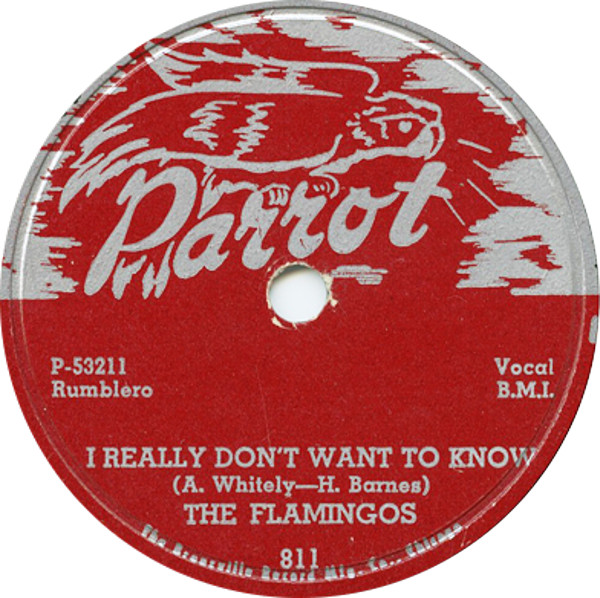
Flamingos # 15: I Really Don't Want to Know
Some time ago in this very blog I dared to suggest that Robert Pruter's assessment of the remaining song from their first Parrot session was mistaken. Mr Pruter had claimed that the arrangement on the country song I Really Don't Want to Know "drags and sounds confused" - but now I'm inclined to think he may be right.
It starts off powerfully enough, with Sollie McElroy asking the question:
Flamingos # 14: If I Could Love You
"Swoonsome" is the term which springs to mind for the opening of If I Could Love You, though not in the teen idol sense. Right from the start the combination of guitar (Lefty Bates) and sax make this little number too darned sensual ever to cross over: if there wasn't an "exotic dancer" present in the studio, those boys must have had awfully good imaginations.
The arrangement as a whole places the song in a sophisticated, supper club setting, and despite its being ostensibly the confession of one who "can't say a mumblin' word" in front of his love this is no adolescent admission of bashfulness but a knowing and playful song of seduction whose climax, so to speak, is the singer's hope that his "oohs" will be returned as moans of delight (listen to the rhythmic emphasis on those final exhalations if you think I'm overstating the case).
Flamingos # 13: On My Merry Way
On My Merry Way was also recorded at the Flamingos' first session for Parrot. Robert Pruter describes it as "a routine jump written by the ubiquitous Chicago nightclub entertainer Walter Spriggs." There is certainly no crossover potential here: it is as far removed, in subject matter and feel, from Dream of a Lifetime as you could get. After a token attempt at reasoned argument -
I want you by my side- the song lurches into another area entirely. Imagine Pat Boone trying to wrap his tonsils around lines such as these:
Hey-ey, can't we compromise?
Subscribe to:
Posts (Atom)