6 August 2017

Flamingos # 17: Get With It & I Found a New Baby


The Flamingos had a larger backing band than usual for two numbers in their final session for Al Benson's Parrot Records. The website devoted to the Parrot and Blue Lake labels notes:
They had been recently performing with Paul Bascomb's group at Martin's Corner on the West Side, but Al Benson preferred to use a studio band led by Al Smith on the date. A four-horn front line (Sonny Cohn, trumpet; Booby Floyd, trombone; Eddie Chamblee, tenor saxophone; and Mac Easton, baritone sax) lent a big-band atmosphere to the two uptempo numbers: "I Found a New Baby," which was held back from release, and "Get with It."
There is no mention of Red Holloway who, it may be remembered, was present, according to the same website, on the other two numbers from that session:
On "Ko Ko Mo" and the ballad, "I'm Yours," the group was accompanied by just Red Holloway, with Horace Palm (piano and organ), Quinn Wilson (bass), and Paul Gusman (drums).
Did Holloway also contribute to the two big band-style numbers?

3 August 2017

Flamingos # 16: I'm Yours & Ko Ko Mo

[Marv Goldberg]


The Flamingos' second (and final) session for Parrot also yielded some notable sides. The pick of the bunch is the ballad I'm Yours, even though it was only a B side for their cover of Gene and Eunice's Ko Ko Mo.

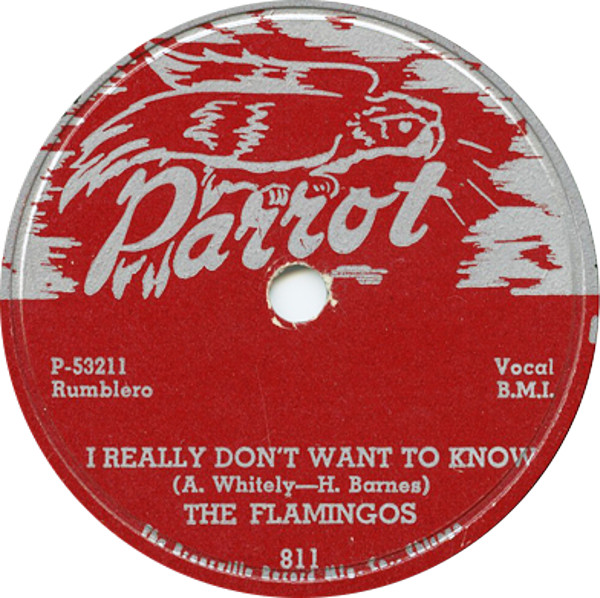
Flamingos # 15: I Really Don't Want to Know


Some time ago in this very blog I dared to suggest that Robert Pruter's assessment of the remaining song from their first Parrot session was mistaken. Mr Pruter had claimed that the arrangement on the country song I Really Don't Want to Know "drags and sounds confused" - but now I'm inclined to think he may be right.


It starts off powerfully enough, with Sollie McElroy asking the question:

Flamingos # 14: If I Could Love You


"Swoonsome" is the term which springs to mind for the opening of If I Could Love You, though not in the teen idol sense. Right from the start the combination of guitar (Lefty Bates) and sax make this little number too darned sensual ever to cross over: if there wasn't an "exotic dancer" present in the studio, those boys must have had awfully good imaginations.

The arrangement as a whole places the song in a sophisticated, supper club setting, and despite its being ostensibly the confession of one who "can't say a mumblin' word" in front of his love this is no adolescent admission of bashfulness but a knowing and playful song of seduction whose climax, so to speak, is the singer's hope that his "oohs" will be returned as moans of delight (listen to the rhythmic emphasis on those final exhalations if you think I'm overstating the case).

Flamingos # 13: On My Merry Way


On My Merry Way was also recorded at the Flamingos' first session for Parrot. Robert Pruter describes it as  "a routine jump written by the ubiquitous Chicago nightclub entertainer Walter Spriggs." There is certainly no crossover potential here: it is as far removed, in subject matter and feel, from Dream of a Lifetime as you could get. After a token attempt at reasoned argument -
I want you by my side
Hey-ey, can't we compromise?
- the song lurches into another area entirely. Imagine Pat Boone trying to wrap his tonsils around lines such as these:

29 July 2017

Flamingos # 11: Listen to My Plea


Listen to My Plea was one of the last sides the Flamingos recorded for Chance. An earlier attempt at the song during their Christmas Eve session in 1953 must have been deemed unsatisfactory as they remade it the following year. The website devoted to the label states:

27 July 2017

Flamingos # 10: September Song


September Song was well on the way to becoming a standard by the time the Flamingos recorded it in 1953. Written for the 1938 Broadway  musical Knickerbocker Holiday, its fame had recently been boosted by inclusion in the film September Affair (above) although many singers including Frank Sinatra, Sarah Vaughan and Billy Eckstine had already tackled the number in the forties.

It's hard to single out a version which might have served as a particular inspiration for the group. The Ravens' 1948 attempt might seem a likely suspect, given that Robert Pruter has accused them of imitating the Ravens on another occasion, but Sollie McElroy brings more passion to the lyrics than Maithe Marshall's rather dreamy caressing of them, beautiful as that is.

19 July 2017

Flamingos # 9: Blues in a Letter & Jump Children


The Flamingos' penultimate session for Chance took place on Christmas Eve 1953 and consisted of four sides: Blues in a Letter, September Song, Jump Children (aka Vooit Vooit) and Listen to My Plea.

16 July 2017

Flamingos # 8: Hurry Home Baby


Hurry Home Baby is the only song from the Flamingos' first session yet to be discussed in this series, although Robert Pruter's succinct dismissal has already been quoted:
... an imitation Ravens number that made nobody forget about the Ravens.
I'm guessing Mr Pruter is referring not only to Jake Carey's bass lead but also that "doo-doo dooh- doo, doo-doo dooh-doo" backing refrain, characteristic of such Ravens records as Summertime and Careless Love. Rather corny to today's ears - mine, anyway - I assume this was employed by the group partly as a means of being quickly identified.

Flamingos # 7: You Ain't Ready


Guitarist Lefty Bates can be heard to good effect on You Ain't Ready, another side from the same August 1953 session as Plan For Love. He may not get a solo, but after the whole band have set up the song he can be heard momentarily on his own before Sollie McElroy's vocal, and later his playing under Red Holloway's exuberant saxophone solo gives it even more bounce and interest; small wonder, according to his own testimony, that everyone wanted him on their sessions.

The whole band, in fact, is really firing on all cylinders throughout. I know that, in the UK at least, many doo wop fans have a strong attachment to Jump Children (aka Vooit Vooit), which has been released on many compilations, but for my money the playing here is more fluid, less brash, perhaps aided by the fact that the band is, I think, slightly smaller.

15 July 2017

Flamingos # 6: Plan For Love


Plan For Love is an interesting performance in the context of the Flamingos' other work at this time, although it's not hard to see why this bluesy number wasn't a success when released.

Recorded around August 1953 it is, unusually, a Johnny Carter lead. It's also distinctive because two falsettos are heard during much of the song. Sollie McElroy's is the main one, I believe, with Carter joining him as other duties permit. It's an interesting and unusual effect, although the combination of the two voices is less pleasing,  to my ears, than Carter's solo decoration on so many other sides.

15 September 2015

Theatre Book Prize judge Viv Gardner on Funny Bones

If you haven't visited the blog dedicated to Freddie Davies's autobiography Funny Bones, which I cowrote, here is a review of the book from Professor Viv Gardner (above, as painted by Daphne Todd), one of the judges of the 2014 Theatre Book Prize:
This is one of those stories that just have to be told. It is unique – there has never been quite such a long and varied a career as Freddie Davies’s - but it is also the story of popular entertainment over the past 70 plus years: the hey day and decline of variety, clubs, cabarets and cruise entertainment, the rise of television comedy and subsequent changes in fashion, and the shifting relationship between popular and ‘high brow’ performance. Freddie Davies has played every type of theatre in the country, from working men’s clubs and Butlins to the Royal Shakespeare Company, television and film, though his earliest memories are of the halls and variety theatres of the forties where his grandparents worked. His autobiography is replete with names and places, many long since forgotten, details of acts – his own and others’ – and whole bills. It is also a ‘back-stage’ story. Davies has worked not just as a performer, but also as a producer, so the autobiography charts not just his own stage career but also the challenges of working with and supporting other artists – the ups and downs, the nuts and bolts of the entertainment business.  A researcher’s dream.  It is a fascinating and important story, not just a personal but also a social and performance history.

Viv Gardner
Professor Emerita, University of Manchester
Judge, Society for Theatre Research 2014-15

8 July 2015

The Spaniels # 2

The previous post was a bit convoluted so I am going to add something today which will, I hope, be clearer. In the meantime I have been rereading Richard G Carter's book on the Spaniels, which can be recommended. It's not necessarily superbly written throughout, but where it scores is that there is a degree of frankness about it which made me wonder at times whether it was wise for the group to embark upon it - at least if they were expecting a PR job.

But I'm glad they did, because you really are taken into the heart of things. Although the book was published in 1994 it ends before they have gone to London, so presumably the MS was completed around 1991. There is a lot of optimism and hope from the various members at the end, though I couldn't say precisely how much success the group had in later years. Group members seem to assume they're on the verge of a huge breakthrough - or at least are entertaining the possibility - and that finally they will get the money and acclaim which is their due. Whatever level of success they did enjoy I don't think it matched up to their expectations.

7 July 2015

The Spaniels


After seeing the current version of the Spaniels in the BBC's Rock 'n' Roll America I resolved to find out a bit more about the group's various lineups. The above is a videocap from the programme; all I can say for certain is that Billy Shelton is on the far left.

From my memory of Richard G Carter's biography of the Spaniels there were two main lineups of the group which recorded on Vee Jay, and the original members were more instinctive singers than the Mk II version. It was the originals who were reunited in the 1990s and whom I saw perform in London.

Detailed information about personnel changes can be found online in Unca Marvy's R&B Notebooks, an invaluable resource for the doo wop fan. His page about the Spaniels, based on interviews with Pookie Hudson, can be read in its entirety here. Pookie's first group was formed in 1949 at Roosevelt Junior High in Gary, Indiana, when he was fifteen. Billy Shelton was a member of this, though the group which were to become the Spaniels were a separate entity:

6 July 2015

All You Need Is Love (Tony Palmer's documentary series)


Having mentioned Tony Palmer's pioneering 1970s series All You Need Is Love, a history of the many strands of popular music, in the previous post here is a review I wrote at the time of its first DVD release in 2008.
I saw the original series when in my teens and have seen many, many documentaries on myriad aspects of popular music since then. So is this worth buying? The answer has to be a resounding yes: the original film material and the range of authorities Tony Palmer gathered together for this mammoth 70s project mean that it remains a vivid account of the genres which coalesced into rock.
Yes, some sections feel a little dull, and the quality of the film transfer doesn't help in the immediacy stakes, but Palmer has two big things going for him: recognised experts in their fields (eg Sondheim on musicals; Lyttleton on swing) wrote the scripts which became the basis of each programme and - crucially - interviewees are given ample time to talk. You get the likes of Hoagy Carmichael and Irving Caesar discussing their own songs, and there's even a bizarre turn from Phil Spector (who appears to be singing his hits in the style of Bob Dylan). Whatever the outcome, Palmer would have deserved our heartfelt thanks simply for the foresight to do something on this scale while the names involved were still around, if occasionally frail.

5 July 2015

Rock 'n' Roll America (BBC 4 documentary series)


Just watched Episode One of the new BBC 4 series Rock 'n' Roll America, which will be available on BBC iplayer for a month (for those in the UK, anyway).

It was a particularly clear and effective retelling of what has become an oft-told tale, with enough freshness in the detail to mean that it can serve equally well as an introduction to the social roots of rock'n'roll and as a reminder of the music's importance for those who have read the books and seen the other documentaries. Archive clips seemed to have been very carefully selected and, crucially, the programme's length meant a decent chunk of time was devoted to the consideration of the contributions of key individuals. Each episode (this was the first of three) is an hour long, though the pace never seemed to flag in this debut show.


The great strength of the programme was the way in which the social background to this upsurge of a new kind of music was firmly sketched in.

Statcounter