It may not have been Ken Campbell. Well, no, it was Ken Campbell, obviously, but it may not have been Ken Campbell, is what I'm saying. Originally.
So my hailing him, in his soft black felt hat, as he was about to get into, or was possibly getting out of, a car in Parliament Hill Fields was, or may have been, on balance, a mistake.
But I wasn't to know that at the time - indeed, had no possible means of knowing that, what with my friend and his wife - the ones who don't read the blog, so it won't much matter what I say, even though I do strive for accuracy, what with the the hand of history a-tickling of my shoulder - with them, as I say, the only ones who had ever laid claim to witnessing the event - which was, or had been, a non-starter, chartwise, on two separate occasions (nothing to do with me, I hope), hence the - well, the obscurity of this promo video, and so the doubt on an early evening in the 1990s, as I crossed the road in search of answers from the soft felt-hatted one.
I can see that I've started too quickly. So let's leave my late nineties self frozen in the act of making some kind of hailing gesture, and let's have - well, let's have some kind of doubt or fear creeping over the features of Ken Campbell as, turning to another TV screen, we rapidly rewind ....
Having referred to The Yellow Balloon in the previous, entirely frivolous, post, perhaps now would be a good time to restore a modicum of sanity with the following review of a recentish DVD box set of London-based films. Anthony Newley stars in one, and although Sparrows Can't Sing is not a musical (despite a title song by Lionel Bart) it is, like What a Crazy World, a film adaptation of a Theatre Workshop production.
If you are thinking of buying this box set because, like me, you know one of the films, then I'd say it's worth taking a punt. I bought this primarily for Pool of London, an Ealing Classic which doesn't seem to be on any of the Ealing box sets, but all of the films here are worth seeing (though I haven't yet seen Les Bicyclettes de Belsize). And several appear to be released on DVD for the first time.
Remember that Alan Yentyob documentary about Bowie? That's right, in the long-ago when Yentob didn't feel the need to interpose his physical self quite so much between the viewer and the subject, yeah?
Well, remember all that cut-up writing he was doing, like Mr Burroughs in The Newcomers. What? No, you remember Mr Burroughs, surely?
He looked a lot like Norman Bi -ird,
Drove a Morris Minor van
Campbell Singer - that was it. Anyway, you know that cutting-up thing, and Bowie saying proudly, "Yes, that's how I came up with the Laughing Gnome, whereas Marc actually thinks he's a poet," and then subsiding into sniggering and complaining there was a fly in his soup, yeah? All coming back to you now?
Suppose I ought to let readers know that Donovan will be performing the whole of the Sunshine Superman album at the Royal Albert Hall on Friday June 3rd. I had known about this already, but reading the new edition of Mojo magazine I see that John Cameron, responsible for the arrangments on Donovan's classic 60s recordings, will be part of this and there is an orchestra to back him - in other words, this is not just yet another night with guitar. I had a look at the Royal Albert Hall website, and saw that the cheapest tickets are £20 but couldn't actually see any available: £30 looks more likely.
And I suppose the question is do I now care enough, or am I willing to take the risk of disappointment, to schlep out there and back? The answer is probably not - and if you have read my earlier post about Donovan performing at the Festival Hall you will understand why.
But I am tempted - if only to have my disappointment confirmed in a masochistic sort of way. Or maybe I should accept that my experience of Donovan live has already been bookended by the Green's Playhouse and Festival Hall gigs.
One of the better sketches in the variable BBC comedy series Big Train - in fact, the only one which has stayed with me - imagines a heavily bearded George Martin as a Terry Waite-style hostage, speaking at a press conference after his release. Whatever question Martin is asked, he immediately responds with one or other of the well-worn anecdotes about the Beatles: not realising John was high when he sent him to the roof for a breath of air, etc.
I don't know what the average viewer made of it, but for someone who thinks about the Beatles maybe a little too much (and hey, there's a dullblog for that), it was screamingly funny - on a first viewing, anyway. If you do fall into the latter category, try it if you haven't seen it:
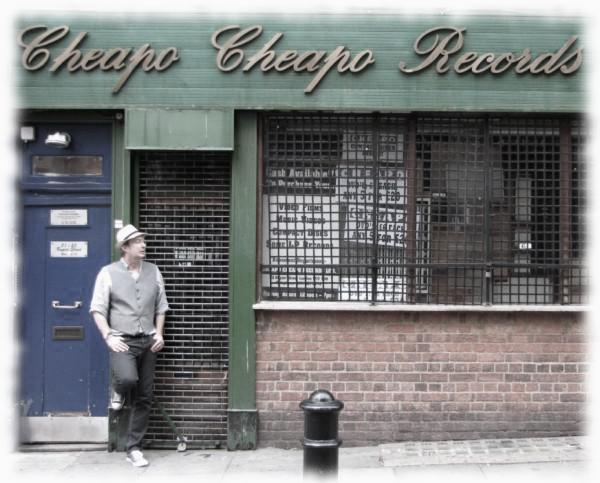
Normally around this time of year I attend a work-related lunchtime event in the West End then beetle off to root around in Cheapo Cheapo Records.
Today, the event over, I thought now would be the time to brave MADD, the mango-based dessert cafe which has sprung up in the spot where once Cheapo stood.
More details about the translated Cheapo, taken from the blog of "specialist branding agency" Underscore.
The owners appointed underscore to devise the name and create a fresh and funky brand to take their exciting concept to the market. The name itself is a mix of the words Mango and Addict, as most choices on their truly unique menu contain the superfruit Mango in some shape of form ...Our communications needed to be playful, versatile and bold to establish a new brand in such a busy location as Soho – which is why MADD is the perfect name for this destination restaurant.
So now you know the Rest of the Story. An "exciting concept" indeed.
Oh, and if you have any allergies, please let them know before ordering. Thank you.
Saw this for myself tonight, already knowing it was inevitable, as I had seen, a few days after the last entry, signs of some kind of counter being put up in the Cheapo Cheapo Records space, but above is final proof. It has happened. The shop I loved, the place which sustained me through amateur and professional associations (oh, read the relevant entries, if you can be bothered to find them) is now ... "London's first mango-based dessert and coffee lounge."
Don't get me wrong: I endorse the consumption of fruit - at least in theory. And it's a bold move to have an eaterie in the heart of London's West End. Who could have seen that coming? But will the customers be nourished as I was?
I'm delighted to report that Alastair Dougall (above), the Brighton-based singer songwriter who composed the lament for Cheapo Cheapo Records which you can find in the post here, has now recorded a new version which you can check out on his myspace playlist here, along with an album's worth of other tracks.
Stately is, I think, the word to describe this 1955 recording by the Orchids on Parrot Records: the tempo feels unrushed, processional.
I was wrong to describe their more famous Newly Wed as "lumbering" earlier, as that implies clumsiness; what can, perhaps, be said is that the change in Newly Wed's tempo between the wordless opening and the entry of the lead vocal (Gilbert Warren?) is unusual - to these ears, anyway. (I did say I wasn't an expert. Unlike Billy Vera, who describes it properly here.)
You Have Two (I Have None) seems marginally faster, but the disjointed feel of Newly Wed, which fits perfectly with what little we can glean of the couple's story ("Hearts broken - broken in two, / Don't leave me here ..."), is replaced by what sounds like calm assurance or resignation, though at the point of highest emotion ("Tell me you love me, Show me that you care") it becomes clear that the song is a plea for union rather than a celebration of a union already achieved; we aren't given any indication of her feelings either way.
Do you remember the BBC children's show Crackerjack and its tradition (at least before Chas and Dave gave them a theme tune composed with the same care that Lennon and McCartney expended over I Wanna Be Your Man) of a panto-type finale utilising the pop songs of the day?
Have you ever read, seen or been obliged to study King Lear?
Have you ever stopped to ponder what King Lear might have been like if put through the Crackerjack process?
Ah, but did you then transform that idle thought into some semblance of action?
Well, I - or rather a persona I constructed - did.
Unlike he whose mortal remains swirl in infinitesimal pieces around the east coast of Scotland, I'm not any kind of a Northern Soul expert so can't really comment on accuracy of detail in this film - an issue with several punter reviews of the DVD on a well-known shopping website. (Now, had it been doowop ...)
But what I can say, as I'm reasonably sure my late friend would have done, is that this is essentially a coming of age tale which is fairly simple in outline: no huge surprises after the various plot strands have been set up, and the resolution probably won't make you whoop with astonishment either.
Yes, echoing the title of a film by his idol, let George be the one to taunt you with visions of what might have been, specifically the prize which could have been yours had you chosen to enter our John Lennon songwriting competition.
The prize has now been awarded to the only person who submitted an entry and it is, as I forecast, a copy of the 1968 Yellow Submarine Gift Book (spooky).
I had intended to produce a few scans here but it seemed more fitting to reproduce such images as I could find on the net: why should those who chose not to enter be rewarded with uniformly high quality reproductions which might act as a substitute for the experience of owning such an item instead of a tantalising glimpse of riches now unattainable?
So below are a variety of images, from a well known auction site and elsewhere. Note that one seller is quite open about the scribblings which have lowered the value of the item.
That it may have been inevitable doesn't make the death of Gerry Rafferty any less sad. I got to know his work through his second Humblebums album, Open Up the Door - and a few days ago, listening to stuff fairly randomly on spotify, clicked on My Singing Bird and marvelled once again at the perfection and simplicity of it
.
You could draw comparisons with McCartney, and wonder why (at that time) he hadn't had similar success, though my immediate elder brother (whose album it was, and who had already seen them live) said that maybe the trouble was he didn't have a George Martin producing him.
I don't know. But today, reading an obituary in the Guardian written by Michael Gray, his personal manager ("employee not Svengali") during the time of his greatest solo success, one passage leapt out:
He did not want to have to out-platinum himself: he had money enough, and disliked being recognised. But behind an aggressive front, and a strong awareness of his own musical excellence, was fear. He turned down working with Eric Clapton, McCartney and others, telling [his wife] Carla "nobody was good enough". In truth, he dared not sit down with superstars without a drink or five. So he sat at home – now 300 acres of Kent farmland and a Queen Anne house in Hampstead, north London – and convinced himself he could work alone with [Hugh] Murphy. Carla said later: "He was just stalling for time. Maybe some new project would suddenly happen, but I knew he'd crossed the line as far as the record business went."
Spotify link to My Singing Bird here. Full Guardian obituary here. STV interview from 2001 here. The TRUE story of how I fell out of love with Donovan here. Strangers on a train: meeting Jake Thackray here.
This isn't really to do with music - or only with music as an incidental ingredient - but I feel compelled to write something about Peter (not David) Bowker's dramatisation of the early years of Morecambe and Wise which was shown on BBC 2 last night and will presumably be available to readers in the UK for a further week on the BBC's iplayer here.
As with Beatle-related biopics I am both helped and hampered by my knowledge of the subject, so that it's hard to judge it - or, indeed, to submit to simple enjoyment.
Time has now been called on our John Lennon songwriting competition (see post here, but it's academic now).
I have to report that as no entries by other hands have been received then technically the prize has to go to me, as the only person to have contributed a snatch of song in the appropriate mode. True, it was intended merely as an example of how to go about things but if it's the winner by default then my hands are tied. So I can only say - as I would have done to any worthy winner - very well done.
Ooh, I'm all excited now - never win things, me. What could the prize be? Perhaps a vintage copy of the Yellow Submarine Gift Book from 1968, telling the story with lots of colour drawings and possibly written by Hunter Davies?
Have just finished watching the above BBC TV documentary about Ray Davies and a review in the Independent, readable here, gets it roughly right, so I probably won't say too much more. The review ends:
if there was a lingering sense that Davies was being indulged, that his nostalgia was slipping into downright despondence, we could forgive him on the grounds that he has done so much for us.
As a reluctant nod to the season, herewith Christmas Prayer, a lesser-known Valentines track from 1955 - at least it isn't on the Collectables Best of collection that I have. I first came across it on a UK compilation of Christmas-related songs from "the Roulette family of labels" on the now-defunct Westside label, which issued quite a lot of doo wop.
As the Collectables CD of the group's Rama recordings includes an amusing but hardly essential snippet of song in praise of Boston DJ Joe Smith, I'm surprised by Christmas Prayer's absence. It was released at the time and an A side, and it isn't just a novelty: the rough edge to the singing and harmonising is highly pleasing to these ears, despite the corny saxophone quote ("jingle all the way") just in case anyone should be in any doubt about the seasonal nature of the song.
I presume Richard Barrett, the man who discovered Frankie Lymon, and later achieved fame as a producer, is the lead vocalist, and we're definitely talking gospel-inflected, soul-anticipating mode. And it sounds like there was a bit of leeway in the harmonising too - it's not that the singing is ragged, just that it doesn't sound rehearsed to death, and that another take might have been different again. Anyway, have a listen and see what you think.
I see from the magic of statcounter that someone who googled the above question today was directed to the Gnome Thoughts ... 25 post on this blog rather than, say, post 3, which is all about the film. Presumably google picks up words from the labels on the right as well as the posts, which is unfortunate, but if that person should chance to revisit this blog then I think I'm fairly safe in saying: no. There wasn't. I've certainly found nothing online and have searched thoroughly.
I can't pretend I listened to every single edition of Mark Lamarr's BBC Radio 2 show Shake Rattle and Roll - too much non-Carl Perkins rockabilly for me - but I am very sorry indeed to see it go.
Last night I listened to the final edition, which will be accessible for a week on the Radio 2 website here. He has circulated an email about his resignation, readable in full at the end of this post, but towards the end of last night's show he acknowledged that Shake Rattle and Roll had a "tiny but dedicated" audience, with the clear implication that the BBC were no longer able to tolerate the "tiny" part of that. Er, isn't that rather the point of the BBC?
It is a great pity, not only because of his presenting style (the true voice of an enthusiast) but because there sure won't be much chance of hearing almost any of the tracks he played anywhere else on the Beeb - the odd Bo Diddley number, perhaps, on Paul Jones' blues show, but that's about it.
Last night was all listener requests, and the final track was an inspired choice as a sign-off, one which I knew well but never, ever imagined I would hear on national radio ... well, never anywhere but there, and a final, fine example of his tradition of playing a doo wop number as a closer.
This is to alert readers that Ian Whitcomb's peerless radio show has moved from Luxuria to XM 24. My post about his Luxuria programme, readable here, still holds good, although the blurb on the XM 24 website here says it rather more succinctly:
The Ian Whitcomb Show is an hour-long fun fest featuring an eclectic and exciting panorama of American and British popular songs, ranging from Tin Pan Alley ragtime through 1920s crooners and dance bands to raunchy pioneer 1950s rock ‘n’ roll. Join host Ian Whitcomb, 1960's Brit Invader, music historian and ukulele maven, on The Music Summit.
Details of the currently free to download podcast version here.
Shows run for one hour rather than two but the shorter format, or perhaps a different hand on the production tiller, or something, makes the shows sound a bit tighter.
And either his voice has suddenly become richer and deeper or the quality of broadcast microphone employed has drastically improved with his transfer - or both? I shall forbear from using the word "slick" as it's still the essential Ian, although I suspect this version of the Ian Whitcomb Show will gain more converts among people who don't already know much about some of these genres. Which can only be a good thing: as I said in my earlier review:
Whitcomb's awareness of the deep, tangled roots of popular music means that he is able to make the most illuminating comments in his show en passant, seeing the sort of connections others wouldn't
so why not download a few shows and get yourself illuminated? The most recent programme is entitled Whistlers, Yodellers, Zithers and Such, featuring, among others, The Waikiki Swingsters, the Pan American Marimba Band, Reginald Dixon, Guy Mitchell ... and Rolf Harris. Now that's what I call eclectic.
At the time of posting you can also download shows about accordion music, what he calls "Transcendental Tunes" (more Mills Brothers and Flanagan and Allen than the Lemon Pipers) and others. His British Invasion Revisited show studiously avoids the Beatles in favour of the names less often played and towards the end of he let slip a detail which will be of interest to regular readers.
Apparently, when the New Vaudeville Band's Winchester Cathedral first became known in the States, so many people assumed it was Ian that eventually he got tired of denying it and went along with it, even singing it in his act, thus adding to the already impressive list of his musical and literary achievements over the years "self-confessed surrogate Alan Klein." How many others can make that claim, even today?
Actually, I've just listened to the programme again and it seems his impersonation actually took place in the happy no-time between Geoff Stephens' intention to make the New Vaudeville Band flesh and the actual hiring of members. So who can blame him for spying a gap in the market?
For a while I though it was so obscure there might not be an image of the above album cover online, but of course there was. I bought it, I suppose, because of the Marble Arch brand. Marble Arch was Pye's quality (ie the records were sonically good) budget label, a reassuring sign because the very first album I bought was Donovan's Fairytale in that form. Marble Arch covers always had white bars at the top and bottom and you were informed of key song titles.
So the series was easily identifiable, the records themselves were substantial - ie fairly heavy pieces of vinyl, even though the running time was never overgenerous. Donovan's album had a few tracks knocked off, for example, presumably so that, a la the Fabs' American issues, there might be eventually be enough material to enable a new album to be fashioned out of those offcuts.
But other than the reassurance of the tried and trusted label, whatever made my ten or eleven year old self decide that my next purchase had to be an album devoted to the Lemon Pipers?
I must have heard and liked Green Tambourine, and at some point, during some family holiday, my immediate elder brother told me he had just heard a broadcaster announce, just before playing Rice Is Nice, also by the Pipers, that he didn't really look this newfangled pop but that "One must be 'with it' to a certain extent."
But that was about it. I knew nothing else by them and I hadn't particularly hungered and yearned to hear more. Nor can I remember the act of buying the record or seeing its cover - as had been the case with Fairytale - tantalising me from the window of a now-vanished shop. And if you look above, you'll see that Marble Arch's graphics team hadn't exactly pushed the boat out for this American act.
And pretty soon I had sold the album on, to a sister of a schoolfriend, if I remember correctly. I don't know what she made of it, as I never met her, though I can probably date the transaction to 1970 at the latest - or maybe even 1969, the year of the album's issue. And I haven't thought much about the album, or the group, in the intervening forty years: when Green Tamourine crops up in a compilation or on the radio it's a pretty period piece, but I only half-listen.
So why am I writing about this album now? Blame the magic of the internet, and spotify in particular. I was compiling a vaguely psychedelic playlist and remembered one of the songs from the album whose title, at least, spoke about the times: Love Beads and Meditation, and I listened to a few other songs I dimly remembered from the LP I'd quickly recycled.
And my verdict: no, not a neglected masterpiece, but what with the overfamiliarity of more well known artists of the time, it felt refreshing to hear those who had attempted to cadge a lift on the bigger names' coat-tails. That song title sort of gives it away that the Lemon Pipers were not unaware of the Beatles' existence but there are other songs which owe clear debts to individual tracks by the Fabs. And it's good to hear them after all this time: to hear, for example, Shoeshine Boy which, like the Bonzos' Equestrian Statue, is a "response", shall we say, to Penny Lane. And actually Love Beads and Meditation may owe more to the group who also stayed with the Maharishi in India, the Beach Boys. And then we have Jelly Jungle (Of Orange Marmalade), though this is less druggy than it might appear, more about the fantasy world two lovers can inhabit.
The one incongruous track on the album was Turn Around and Take a Look, which seemed corny, though I can sort of hear they may have been going for a Lovin' Spoonful-type feel (their labelmates back in the States, in fact). And I think Paul McCartney admitted Good Day Sunshine on Revolver "borrowed" from Daydream, so no one is innocent.
The others I don't remember, though I can see they included a cover of Wasn't Born to Follow.
Having written the above, I realised I ought to find out something about the group, so headed for wikipedia, as you do, where I see that Turn Around and Take a Look was an initial and unsuccessful attempt by a band member to come up with a hit song, and that many of the group's songs were by Brill Building writers Paul Leka and Shelley Pinz. When their Green Tambourine was a hit, their record company, Buddah, put pressure on the group to stay in the bubblegum genre. An article by Larry Nager, here, quotes band member Larry Nave on "the duality of the Lemon Pipers":
We were a stand-up rock 'n' roll band, and then all of a sudden, we're in a studio, being told how to play and what to play.
They left Buddah in 1969 and later "dissolved", which seems an appropriate term. But there is a small footnote: three band members,
Bartlett, Walmsley and Nave formed Starstruck, whose recording of a Lead Belly song, "Black Betty" was reworked by Super K Productions producers Jerry Kasenetz and Jeff Katz, and released in 1977 under the name of Ram Jam, featuring Bartlett.
That was a big hit in the UK, and I actually heard it sung live a few months ago, by Joe Brown. Whose success predated the Beatles. Ee, it's all cyclical. And members of Beatle-influenced 10cc worked with those producers. But rather than getting lost in my own jelly jungle of connections, a final quote, taken from the wikipedia page, taken from the book Bubblegum Is The Naked Truth.
It was the Pipers’ way with a tough-pop gem in the under-four-minute category which was most impressive by far: "Rainbow Tree", "Shoeshine Boy" and especially "Blueberry Blue" each sported a taut, musical sophistication worthy of The Move and, dare I say it, even the Magical Mystery Beatles.
A lightly clad truth, but very pleasing pop nonetheless. Here's Shoeshine Boy:
If the title of this post has already made you think of Dion and the Belmonts' Teen Angel ("Our love is young,/Now we are one") then congratulations: you've probably arrived at the right blog.
If, however, it doesn't, then it's statistically likely that you have been directed here by google images and are in search of non-existent David Bowie downloads and will leave after - eh? Wha - ? Ohhhh ...
Ee, they might have had the courtesy to allow me to finish my sentence, at least. Anyway, for those happy few who remain, in order to mark today's anniversary (One Glorious Year of Blogging), for one day only the title image for this blog will be the original photograph of the Cheapo Cheapo Records shop by Laura Appleyard (see her flickr photostream here) without my embellishments.
Though that wasn't the original title image: I used a detail from a Medallions publicity photograph - Vernon Green's eyes - as, I think, the first, or one of the first, pictures to indicate what that these posts would be about. After all, if anyone held the secret of pismotality, the mystery at the heart of doo wop, it had to be the man who coined the word.
As I've explained elsewhere, I took Pismotality as a username on the Steve's Kewl Doo Wop Shop website simply because my own name, Tony, had already been taken, but I've retained it as much of what I write is about doo wop - plus it makes my work easier to find via google.
I can't remember just when I made the change of title image, but it may have reflected the blog's expansion from doo wop, once all the available Kewl Steve material had been reposted, to all the music of my formative years - and at one time or another Cheapo Cheapo Records, late of Soho, held just about all the albums I had ever bought - or borrowed from my local library back home in Scotland - so it seemed ideal. And the fact the shop had closed down also made me want to commemorate it. I still miss it a great deal.
As there is now a year's worth of blog posts to ferret through, for the busy executive here is a - well, not a top ten, exactly, but a quick list of some entries which may be worth reading if you like anything you've already read here. Well, I enjoyed writing them, anyway, although I appreciate that that may not of itself be an infallible guarantee of quality.
Golden Teardrops - this is my original piece about the record from the ol' Doo Wop Shop board, but with a commentary added when it was reposted here in December 2009. I began to realise that blogs were about going wherever your inclination dictated, which in this case involved an artist who had used a cover from Springboard International's Original Oldies series as inspiration. The reason? I first heard the Flamingos' classic - guitar overdubs and all - on a compilation in that series. Also I accuse a (probably) innocent man over the theft of Lou Reed's doo wop collection. The post was just going that way.
You Have Two (I Have None) - an attempt to capture another great doo wop recording, but at least I have the humility to cite Robert Pruter. Warning: may contain unnecessary traces of Elizabethan poetry.
14 Karat Soul - a longish piece about the best young doo wop group I ever saw in live performance, including The Mysterious Case of the Gesture at the Neck. I still say I was singing in tune.
A Wreath for Cheapo - the most substantial piece about the importance to me of the vanished Cheapo Cheapo Records shop.
On Again! On Again! or Strangers on a Train - Jake Thackray in my life, despite my immediate elder brother's objections. (But can you trust someone who mistook a Bolan fan for his wife?) Plus my time alone with the great man: now it can be told.
Stand By Me Part One - first of two posts exploring the origins of Ben E King's song, looking at the singer's early doo wop years and the signficance of Clyde McPhatter during this period. Part Two focuses more on the song's gospel roots and the beginnings of soul with Sam Cooke and others.
They Turned Me On - Part Three: Hubert Gregg - from a series celebrating the broadcasters who opened my ears to a world beyond pop. I'm happy to say that Hubert Gregg's widow, Carmel Gregg, has read this and seemed to like it.
Gnome Thoughts ... 11 (Well At Least Its British) - a long piece about Alan Klein's neglected 1964 solo album in the context of other comic songwriters. Links at the end to other Klein-related posts.
I started writing this blog one year ago tomorrow, which prompts a post-length period of reflection: is there anything I have learnt? Any wisdom to pass on to regular readers, other bloggers or those considering a blog?
Spoiler alert: No. Well, not really. Not much, anyway.
As a postscript to recent entries linking rock'n'roll to the atomic age, here's a doo wop recording well known to me which is both a cash in and a fresh take on the subject.
This clip from last night's episode of the UK sitcom Peep Show demands a wider audience. And it's music-related (after a fashion), thus qualifying for this blog. In later reviews of sitcoms over the decades the phrase "Danny Dyer's Chocolate Homunculus" will, I am sure, rank alongside Alan Partridge's "Monkey Tennis."
With the thirtieth anniversary of John Lennon's death coming up, I'd like to share my memories of that time, even if this turns out to be an exercise exclusively of interest to me. Other options are available, such as the LENNONYC podcasts where those directly involved with Lennon are asked how they reacted.
This is a very simple, not to mention infantile, idea which could be catching, if any Beatle people are reading this. Hey, maybe it could even be a competition, with some kind of marvellous prize which I haven't yet bought - but it'll be great, believe me.
Anyway, the idea has certainly been floating around in the recesses of my mind for some time, demanding to be shared with others. So here goes.
This series started as an exploration of David Bowie's early influences ("Gnome" as in The Laughing Gnome) but has drifted some way from its moorings: in recent posts about rock'n'roll's impact on fifties Britain, Bowie has been mentioned only in passing.
But then again - and do correct me if I'm wrong - the country's denizens in that decade did include one David Robert Jones, born in 1947. And according to wikipedia, as with Alan Charles Klein (b.1940) and so many others, Master Jones's musical epiphany occured in the magical year of 1956, even though he was only nine at the time:
By way of an extended footnote to the previous post, more about repression in fifties Britain, this time through the prism of radio comedy, plus further evidence of intertwangularity between John Lennon and The Goon Show.
You can find out more about the the Britain in which John Lennon, Alan Klein and so many others grew up in Humphrey Carpenter's book That Was Satire That Was. It's actually about the satire boom which began with Beyond the Fringe in 1960, but there's a prologue describing the decade which led to that moment of release.
Staid as fifties Britain may have been, Carpenter dates the impulse for social change back to the forties. The need for everyone to pull together during wartime temporarily created a "comparatively classless" society, he says, and the mantra of Other Ranks (ie the non-officer class) was that "things are going to be different after the war."
Sure enough, a Labour government was elected in 1945, despite outgoing prime minister Winston Churchill's warnings about incipient Communism. But when this led to an era of austerity - the country had been "virtually bankrupted" by the war - the electorate got cold feet, voted the Conservatives back into power in 1951, and British society reverted to its "pre-war heirarchichal norm."
So what eventually caused that structure to buckle?
Listened last night to another of the very highly recommended LENNONYC "Beyond Broadcast" podcasts discussed in post 29, this time an interview with Colin Hall, curator of John Lennon's restored childhood home, Mendips (above).
The Liverpool slant has meant that none of the material was ultimately useable in the forthcoming documentary, part of PBS's American Masters series, which focuses on Lennon's reinvention as a New Yorker and is due to air in the US on November 22nd.
But as Hall speaks so illuminatingly about the significance of rock'n'roll for British teenagers like John in the fifties it's perfect for this point in the Gnome Thoughts ... series, so I have taken the liberty of transcribing a section below with a few edits.
You can download the complete podcast, which also features an interview with Quarryman Colin Hanton, at the American Masters site here. Hall is the only interviewee so far not to have had any direct contact with Lennon, but he paints a vivid picture of the times, and seems to have been only slightly younger. Dedicated Beatle people will already know many of the details - American records brought into the port of Liverpool by US-infatuated merchant sailors dubbed "Cunard Yanks," for example - but when Hall describes the spectacle of a friend's brother stepping off the boat in all-American gear then it really comes alive.
If you have read recent entries in this blog about the 1950s charts you will find much that is reinforced or confirmed by the interview, especially the comments about the moribund state of British society in Dennis Potter's 1956-set Lipstick On Your Collar quoted in post 19. And it's good to see that he links The Goon Show to rock'n'roll, as at the end of post 22.
New visitors to this blog, or incurious regulars who haven't explored its inner recesses, may also be interested in an earlier blog entry about Nowhere Boy, here. It features quotes from UK reviews of the film, including that of Philip French, who praises its portrayal of a Britain still in the grip of postwar austerity.
The LENNONYC interviewer is Michael Epstein; his questions and comments are italicised throughout. He begins by asking Colin Hall about the initial response to rock'n'roll in Liverpool.
Only one more volume of the Fabulous 50s to go, but if you're not so keen on the tracks which don't come straight from the fridge (like L7, Daddio, you dig?) maybe I could draw your attention to an inexpensive box set which focuses exclusively on British rock'n'roll from the initial 1956 explosion to the early sixties - and not a Ronnie Hilton or a David Whitfield in sight.
I bought it recently on a well known shopping website for 6.99 - the price has now gone up a bit but it's still very good value. If you have access to spotify, here is a link. Doublelick on the image below for a readable tracklisting:
In fact, if you are looking to buy just one cheapo box set which includes, in the sleevenote writer's words, "almost every area in British rock music's rise ... from Big Bands to the Beatles" then this may well be it.
Admittedly, not every single track on this 5 CD set of homegrown rock'n'roll will make the liver quiver, the knees freeze and the bladder splatter (Little Richard's infallible tripartite test for the real thing), but for the average listener - and especially at such a bargain price - this collection provides an excellent overview of the pre-Beatles British rock era, illuminating that time, from the mid fifties onwards, when the likes of Lionel Bart, penning ersatz rock'n'roll hits for the likes of Tommy Steele and Anthony Newley, started the ball rolling for the Fabs.
Here's the tracklisting (including some youtube links) for the 1958 volume of the Fabulous 50s series, plus some brief notes made at the time of purchase:
We are now approaching the end of this series whose major benefit is that you get to see the sort of thing which was in the UK charts that year, not simply the mostly American items which have subsequently become classics.
So in addition to the international biggies on this edition which need no introduction there is also Lord Rockingham (a successful attempt by contemptuous British jazzers including Benny Green to cash in on the rock'n'roll craze, as it was then); Lonnie Donegan still riding high on the skiffle craze; a forgotten Tommy Steele track entitled Nairobi; the non-international Max Bygraves with Tulips from Amsterdam; "Elias and his Zigzag Jive Flutes" plus some early CLiff Richard from the days when he was (briefly) seen as the British Elvis - I think Schoolboy Crush was originally intended as the A side to Move It but the latter track's quality (one of the few British rock'n'roll tracks which would not have disgraced an American company) was unmissable.
Talking of those darlings of the Cold War, a current British TV comedy show has a regular sketch based on a very simple premise: the Beatles are still together, still recording, didn't take drugs, are still with their first wives.
Oh, and didn't die.
It's funny but sort of heartbreaking too: they are now grey-haired moptops, jolly schoolboys bantering with each other as though they're still in Hard Day's Night (the writer gets the style just right), kept in order by a Norman Rossington figure. George Martin features as a strict but fair headmaster type.
It's heartbreaking because you know the ridiculousness and the impossibility of the situation and yet part of you wants it to be true, wants them to be restored at last to their cheeky, unreal selves.







.jpg)


